
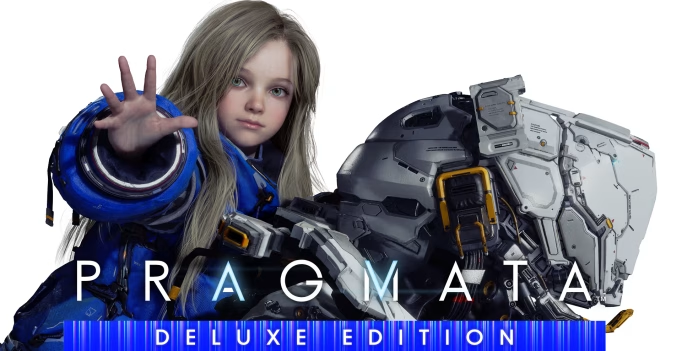
No one can say that Capcom aren’t throwing everything at 2026.
In recent, past years, they’ve had one or two games, focusing on a quality, less quantity approach. The thing is, in 2026, so far they’re three major releases deep – with at least one more to come – and after playing Pragmata, I can say they’ve hit the homerun again.
And this time, they’ve achieved the golden unicorn in building a brand new IP from the ground up and making it one of 2026’s most compelling releases.
Can it even be in the same conversation for Game of the Year like Requiem? I’d probably throw a bit of caution toward that, but this game is unique, smart, and even warm and fuzzy as the relationship between the game’s protagonists grows.
Pragmata starts out like your standard, over the shoulder action adventure, feeling a little bit Dead Space in its opening moments. Again, no bad thing, but it takes an interesting turn when you – Hugh – meet Diana for the first time.
Diana seems like a sweet, innocent young girl you want to protect from the horrors around, but it turns out Diana is a highly intelligent sentient being who has the ability to hack the rebelling robots that seek to hurt you both.

They’re essentially small mini games you play while evading enemies that come at you. Working through small grids that you need to navigate through using the pad buttons – triangle being up and x being down – you need to reach the green central point, but depending which nodes you flow through, you can gain powerup bonuses to defeat your enemies quicker in conjunction with your weapons.
Of course, the hacks get increasingly more complex the tougher enemies you face, and as you’re trying to complete them, you also need to be mindful of enemies hurtling towards you or dropping a giant sword on top of your head or firing lasers at you from range.
This is where Pragmata really stands out and feels quite fresh in that it doesn’t give you a moment to rest but it keeps the action dynamic and means you are forced to adapt strategies on the fly in order to survive some of the more punishing waves and tricky boss battles.
And yet, it’s the game’s heart and soul that truly win you over. The dynamic between Diana and Hugh make for some wonderful conversation pieces as Hugh tries to explain ‘the human condition’ to Diana. There’s one particular scene where Diana is quite reckless with her own body because in her DNA she can ‘just be rebuilt’ but to Hugh, he cannot stomach or imagine an environment where he needs to do that. So he panics and almost reprimands her.
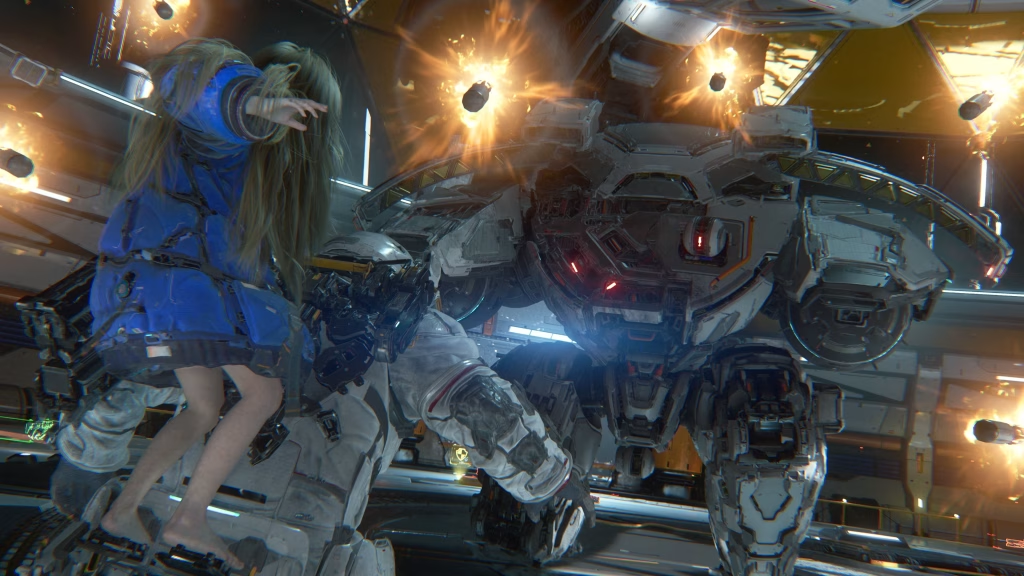
It’s a surprisingly paternal, heartwarming story between the two and despite the game’s linearity, its substance and standards are never in doubt or question. Di rides around on Hugh’s back, using his hard-as-nails body suit to protect her, while she performs computer wizardry from behind and weakens enemies for Hugh’s weapons.
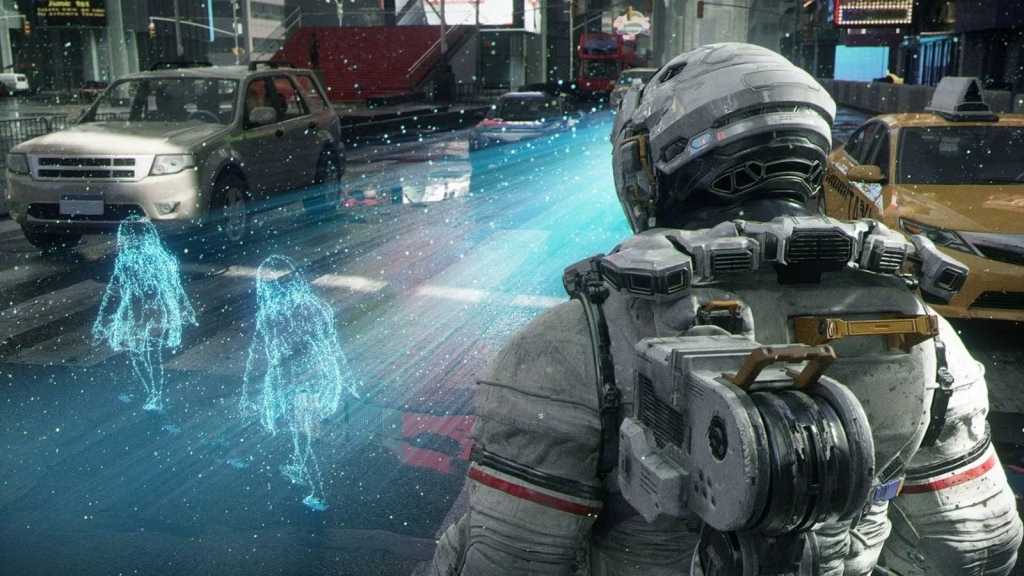
The way the game is polished, the story is told through optional dialogue pieces, smaller, out of purfue environments, you just find yourself continually being won over by monologues about the beauty of New York City or the types of foods humans eat and how they build connections with one another.
It’s all about an artificial intelligence trying to understand human nature, all from the guise of a ten year old girl. And in that, it makes for one of Capcom’s most heartwarming adventures, shorter, sweeter than many of the massive games on the market, but with tight feeling controls, compelling environments, and great storytelling.
For me, this is more in the remit of games like Vanquish and Binary Domain, even harkening back to underated Capcom classics in Lost Planet and Dark Void. Capcom have really gone back to their roots with this one, proving that they’re not just a publisher who relies on their classic IP, but still have new stories they want to tell and that is just so utterly refreshing in a market that often gets saturated by sequel-itis.
The enemy design is a good mix to present constant new challenges and moments of pressure to give you something to contend against while the game tells its story. Though you can dial things down a bit if the combination of hacking and fighting gets a bit overwhelming.
What I would say is the game does sort of stick to a third, and fourth gear, never really pushing into fifth, but that’s absolutely ok and it doesn’t need to. Because the package presented is wonderful and leaves a lasting impression on you once the credits have rolled.

From the melancholic music that paints the picture of an uncertain time, where you learn more about Diana and how she came to be where she is and what sort of world she’s been living within, to Hugh desperately trying to connect with his family and friends after being split apart from them, but now finding he has growing split loyalties with Di.
And that’s the magic of Pragmata, as you watch that bond grow organicaly, naturally, beautifully through writing, through facial reactions, through pivotal moments in game. It just makes everything all the more special.
It’s a weird one, because, I was sad to leave this one. Sad to finish. Sad to beat it and complete it, because it left an indelible mark on me. I felt like I’d been on a journey, one where I got some time to have personal reflection, one where I was enjoying myself while playing, and one which managed to feel surprisingly fresh in addition to being a whole new world.
Because it’s on the RE Engine, this one is just as beautiful as Requiem and Monster Hunter Stories, in that regard Capcom rarely ever miss, but I think for me it’s the mashing up of games they’ve made over the years, as there’s a little bit of Devil May Cry in here with the sub-levels you can select, choose from and gather all the collectibles, and there’s upgrade systems ala Lost Planet.
It’s a game I hope is added to the conversation for awards. And it’s a franchise that deserves the chance to grow and evolve, perhaps getting a sequel, though as I highlighted above, maybe it works just as well as a standalone. Sometimes we need to be brave and ok in accepting that as gamers because not every story needs to be overtold.
Pragmata is a joy, though. I caught myself smiling so much and it shocked me because I genuinely wasn’t expecting this particular game to get me like that. In a deluge of releases that often try to be a bit of everything, Pragmata is compact, confident and compelling all at once.
It is truly a special release that is sure to become a cult hit in years to come and another reminder that Capcom are a publisher at the absolute top of their game, with an Onimusha sequel still waiting in the wings later this year. At this rate, there’s no competition for who Metacritic’s best publisher of 2026 will be.
Verdict
Pragmata is an absolutely delightful action adventure that successfully builds an exciting new IP and builds it around a blossoming, beautiful relationship between its central characters. It’s heartwarming, it’s action-packed, filled with the most melancholic, delightful music, thoughtful, pleasant dialogue that brings a smile and a tear, and creative gameplay mechanics that stay interesting and different enough so they don’t entirely wear out their welcome. Pragmata is destined to be yet another cult Capcom classic and is yet another homerun in a year of bangers coming out of their front doors.

Pros
+ Heartwarming storytelling with thoughtful dialogue
+ Compelling, unique action that manages to mostly stay fresh throughout.
+ A good length with quality content that will make for a Capcom cult classic.
Cons
– Some monotony in mechanics towards later stages
Pragmata is out now on PC, Switch, PS and Xbox.
Reviewed on PS5
Code Kindly Provided by Capcom for review purposes

You must be logged in to post a comment.